

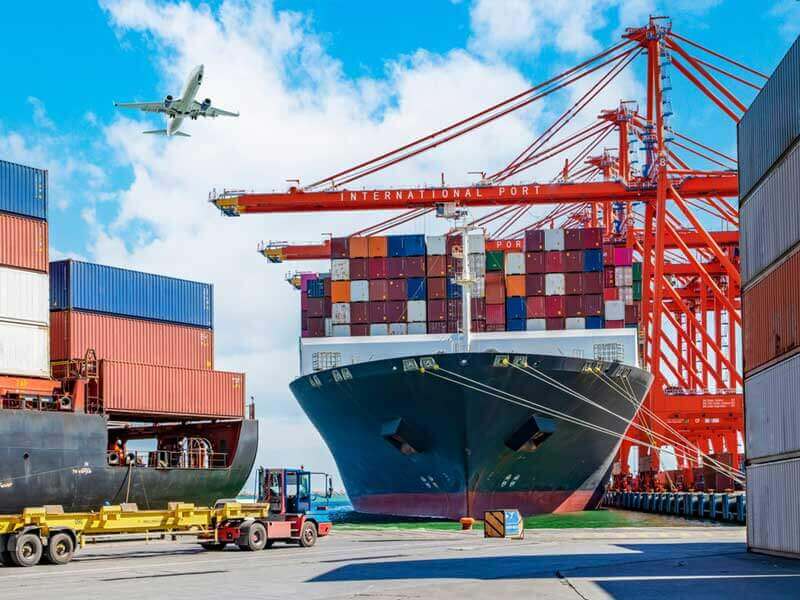
Landed cost is the total, all-in cost to get imported goods from the seller to your final U.S. destination. Your landed cost includes a multitude of expenses. For U.S. importers, landed cost is the number that ultimately determines true margin and price-per-unit. This guide is for importers that want to know the different landed costs that could affect their imports, how to reduce these costs, and when they should be paid.
Key takeaways
- Landed cost is a stack of costs, not a single fee: product value, transport, compliance, and port and warehouse charges.
- Incoterms@ determine who pays which expenses and when, but they do not remove costs from your landed cost model.
- Harmonized Tariff Schedule (HTS) classification, customs value, and country of origin are the biggest drivers of duties and tariff exposure.
- Destination-side costs (drayage, terminal handling, storage, demurrage/detention, exams) cause many of the largest surprises.
- The best landed cost models separate predictable, statutory costs (duties/fees) from variable, controllable costs (routing, packaging, service level), then reconcile every shipment.
With that foundation, here’s the practical breakdown you can use for estimating and auditing landed cost.

TARIFFS CHANGE DAILY - ARE YOU STILL GUESSING?
Estimate Your Landed Cost Before You Import
Use our Landed Cost Calculator to estimate duties, fees, freight, and destination charges so you can price imports with more confidence.

Real-time tariff intelligence built into every estimate.
What’s Included In Landed Costs
A landed cost model for U.S. imports usually includes these categories:
- Product value
- International transportation
- Domestic transportation
- Customs duties and tariffs
- Taxes and government fees
- Customs brokerage, filing, and compliance costs
- Port and warehouse charges
We’ll discuss the intricacies of each and explain how they affect your overall landed costs.
Product Value
Product value is the declared customs value of imported goods that's typically based on the transaction value paid by the buyer and adjusted when required for certain additions.
The product value should appear clearly on your commercial invoice. If it doesn’t, Customs and Border Protection (CBP) will do it for you.
Here’s why product value matters:
- Product value is a major input into duty calculations and some fee calculations.
- Small documentation gaps can create delays, holds, or requests for clarification.
Here’s what you should do when documenting:
- Make sure the commercial invoice is complete and consistent: clear description, quantity, unit price, currency, country of origin, and selling terms.
- Track items that can affect value like commissions, assists, royalties, and production costs
- Keep internal purchase terms aligned with shipping terms so information across your invoice, packing list, and entry data are accurate.
When your commercial invoice and other documents are inconsistent, it increases the chance of delays and post-entry clean-up, both of which raise landed cost.
International and Domestic Transportation
In the context of landed costs, transportation is split between the following.
- International Movement (port origin to U.S. port/airport)
- Domestic movement (U.S. port/airport to warehouse or final destination)
This separation is useful because different vendors, different timelines, and different risk factors apply. Multiple methods of transportation are used for both international and domestic transport. We’ll start by discussing ocean freight.
Ocean Freight
Ocean freight is the cost to move cargo by vessel and is typically used for international shipments.
The following are factors that contribute to ocean freight costs:
- Base ocean freight
- Carrier surcharges
- Origin charges
- Destination charges
- Container-related add-ons
Here’s how you can get an ocean freight estimate:
- Request an itemized quote that separates origin, ocean, and destination charges.
- Compare the landed cost per unit, not only cost per container.
- Assume volatility: ocean pricing and accessorials vary by season and port conditions.
Vessel transport is the cheapest when shipping in high volumes, but it’s also the slowest.
Air Freight
Air freight is the cost to move cargo by aircraft. Imports can travel by air internationally or domestically once they’ve successfully entered the United States.
Air rates are commonly driven by:
- Chargeable weight
- Surcharges
- Handling fees at origin/destination
How to control air freight landed cost:
- Use air strategically for time-sensitive, high-value shipments.
- Improve packaging efficiency to reduce volumetric weight.
- Keep your model per-unit: air often makes sense for service levels, but only if the unit economics are understood.
Shipping by air is faster than ocean, but often more expensive per unit.
Drayage and Port-To-Warehouse Moves
Drayage is the short-haul move from a port or rail ramp to a warehouse or transload facility. This is one of the most common landed costs that surprises importers because it’s sensitive to local capacity and timing.
Cost drivers importers often underestimate:
- Congestion and appointment delays
- Chassis availability and fees
- Port/rail wait time and accessorial charges
- Container weight and size
How to reduce drayage surprises:
- Treat drayage as a primary line item, not a leftover cost.
- Align paperwork early so drivers aren’t waiting.
- Plan warehouse appointments ahead, especially during peak season.
This will help keep your drayage costs more manageable when you import.
Customs Duties and Tariffs
Customs duties and tariffs are government-imposed import charges assessed when goods enter the United States. These charges are typically driven by HTS classification, customs value, and country of origin.
HTS Classification
HTS classification is the process of assigning a Harmonized Tariff Schedule code to a product.
The code influences:
- Duty rate
- Eligibility for certain programs
- Exposure to additional duties, restrictions, or requirements
Best practices:
- Classify at the SKU level whenever possible.
- Use consistent, specific product descriptions across invoices, packing lists, and entry documents.
- Keep product specs ready (materials, function, technical details). Classification depends on what the product is and what it does.
The Harmonized Tariff Schedule is maintained by the U.S. International Trade Commission (USITC), while duty collection and entry is administered by CBP.
Duty Rate
A duty rate is the percentage or amount applied to the customs value (or units) to calculate duty owed.
Common formats:
- An ad valorem duty is a duty whose amount is based on a percentage of their total assessed value.
- A specific duty is a duty calculated as a fixed monetary amount, typically per unit, weight, volume, or quantity.
- A compound duty is a hybrid between an ad valorem and specific duty.
Use a consistent valuation basis for estimating duty and re-check duty assumptions when materials, suppliers, or product specs change. This ensures the correct one is applied to your goods.
Country of Origin
Country of origin is the country where the product is considered manufactured under applicable origin rules.
It can impact:
- Duty treatment
- Eligibility for trade programs like Free Trade Agreements (FTA)
- Exposure to additional tariffs
Don’t assume ship-from country is the same as the country of origin. Always confirm the country of origin with supplier documentation and your compliance process.
Tariffs
Tariffs are the scheduled rates and trade measures that can add to (or modify) the duties owed based on product and origin. In practice, “tariffs” is the umbrella term importers use when duty exposure changes due to trade actions or special measures.
Common tariffs include:
- Section 301 is a law that allows the Office of the United States Trade Representative (USTR) to investigate and retaliate against unfair, unreasonable or discriminatory trade practices with tariffs and other trade remedies.
- Section 232 is a law that allows the president to impose tariffs or other import restrictions on goods deemed a threat to national security.
- Antidumping (AD) duties are levied on goods that are sold to the U.S. below normal market value.
- Countervailing duties (CVD) are levied on foreign goods that have been subsidized and sold to the U.S. at a price lower than domestic manufacturers.
Monitor changes relevant to your product category and origin mix to ensure you’re paying the correct duty on your goods.
Taxes and Government Fees
Taxes and government fees are mandatory charges imposed by CBP and Partner Government Agencies (PGA). These costs are valuable in a model because they are often predictable once you understand your entry type and shipment method.
Merchandise Processing Fees
The Merchandise Processing Fee (MPF) is a fee CBP charges to cover the administrative and processing costs of imported shipments. CBP caps the MPF at a minimum and maximum amount. Updates are made annually, with changes taking effect on October 1st of each year.
The MPF applies to formal and informal entries. Therefore, you should expect to pay it every time you import.
Harbor Maintenance Fees
The Harbor Maintenance Fee (HMF) is a fee applied to most ocean vessel shipments to help fund the maintenance of U.S. ports. You should always factor the HMF into your landed costs if you’re importing goods by ocean vessel. When importing by air, you can disregard it.
Customs Brokerage and Compliance Costs
Customs brokerage and compliance costs are the service and filing costs required to enter goods and manage import exceptions. These costs affect both money and time—errors can cascade into holds, exams, or storage.
Entry Filing and Brokerage Service Fees
Entry filing and brokerage fees commonly cover:
- Entry preparation and transmission
- Document review and compliance checks
- Classification support (sometimes included, sometimes separate)
Best practices:
- Evaluate brokerage quality as “cost avoidance,” not just a line item. A low fee can become expensive if it leads to delays or errors.
Customs Bonds
A customs bond is a financial guarantee to CBP that the importer will comply with entry requirements and pay amounts owed.
Two bonds that are commonly used by importers include :
- A single entry bond is a bond that covers a single imported shipment.
- A continuous bond is a bond that covers multiple imported shipments for an entire year. They auto-renew annually unless canceled by the bond holder.
- A temporary import bond is a bond that allows for duty free importation of goods that are either re-exported or destroyed at a specified time.
Continuous bonds are 10 percent of duties, taxes, and fees paid for a 12 month period, while single entry bonds are an amount not less than the total entered value, plus duties and fees. Single entry bonds are also capped at a minimum no less than $100.
Exams, Holds, Demurrage, and Detention
Imports aren’t always subject to exams, holds, demurrage, and detention. However, you should know how they work if you’re ever hit with one.
- A cargo examination is a document based inspection performed by CBP to ensure imported goods abide by applicable laws and safety standards.
- A customs hold is when your goods are temporarily paused by border authorities.
- Demurrage applies when a container stays at the terminal beyond free time.
- Detention applies when a container stays outside the terminal beyond free time.
Each of these can inflict additional costs on your import. Carefully planning how you will get your imports out of a port and following applicable regulations will prevent your goods from being hit with these charges.
Surprise Costs and How To Prevent Them
The last thing you want is to calculate your landed costs and be hit with a surprise expense when your goods enter the country. Unfortunately, there are numerous mistakes importers often make that lead to unexpected costs.
This includes:
- Incomplete or inconsistent documents
- Misclassification or vague product descriptions
- Underestimating destination charges and drayage
- Assuming “all-in” quotes cover delivery to final destination
- Congestion-driven delays that trigger storage/demurrage/detention
Here’s a checklist you can follow to prevent surprise expenses:
- Maintain SKU-level product specs and consistent descriptions.
- Standardize a landed cost template and require itemized quotes.
- Track free time and schedule pickups early.
- Reconcile estimated vs actual costs after every shipment and update assumptions.
Keeping these items in check will prevent you from getting hit by unexpected fees on your goods.

Speak with a Licensed Customs Broker to review classification, duties, fees, and shipment variables that may be increasing your landed cost.
Testimonial from Dr. Khalil M. - He was a time-sensitive importer that utilized USA Customs Clearance's consulting services.
“It was great speaking with you, and thank you again for all your guidance during our consultation.”
Negotiable vs Non-Negotiable Costs
You can alter the services you use when importing to give yourself a more favorable landed cost.
This includes:
- Mode and routing (ocean vs air; direct vs transload)
- Forwarder/carrier selection and service level
- Packaging efficiency (CBM/chargeable weight)
- Delivery planning (reducing waits and re-deliveries)
- Broker process quality and document readiness
Depending on the specifics of each service and how you implement them when importing, you can bring your landed cost down.
Here are some less negotiable costs:
- Duties and many government fees (driven by HTS/value/origin)
- Exam outcomes and certain port constraints (risk-managed, not “negotiated”)
Influencing costs inflicted by duties can be difficult because they’re set by the government.
Payment Timeline
While landed cost is your total expense to import, you won’t pay it all at one time. Certain expenses will be paid at different points during the importation process. Here’s a table that shows when the expenses we discussed are paid.
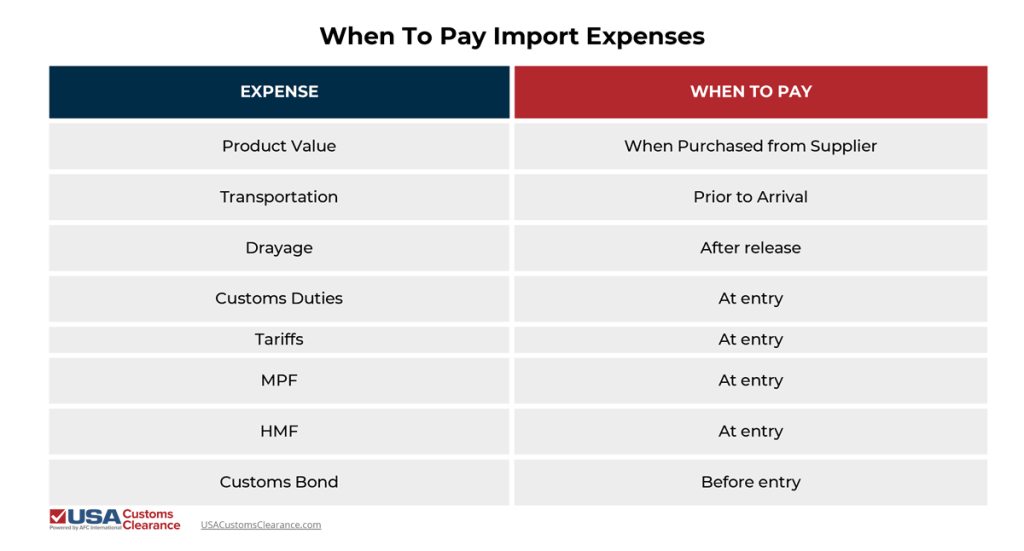
Incoterms@ can also influence when you pay your import expenses. An Incoterms@ is an internationally recognized rule that defines responsibilities for buyers and sellers in international transactions.
Build A Repeatable Landed Cost Model with USA Customs Clearance
What we do:
- Review your product details, shipment terms, and entry data to identify the core landed cost drivers
- Confirm the HTS classification, customs value inputs, and country of origin factors affecting duties and tariffs
- Break down transportation, drayage, port, warehouse, and destination charges into clear cost categories
- Identify predictable statutory costs like duties, MPF, HMF, and bond requirements
- Flag variable or surprise costs such as exams, storage, demurrage, detention, and documentation issues
- Help you build a repeatable landed cost model you can use to estimate future imports with more confidence
Typical timeline: We can begin reviewing your shipment details the same business day and use a 45-minute consulting session to walk through the main landed cost components and risk areas.
What you’ll need: Commercial invoice, packing list, product descriptions, HTS codes if available, country of origin, shipment terms, supplier details, freight estimates, and any prior entry or cost records you want reviewed.
Why choose us: We are Licensed Customs Brokers with hands-on import experience who help businesses understand duty exposure, avoid preventable delays, and improve landed cost accuracy before goods arrive. Our team also has 90 years of combined experience.
Outcome: You get a clearer, more repeatable landed cost model that helps you estimate total import expenses, protect margin, and reduce surprise charges. You can reach out to us on our contact page or call our team at (855) 912-0406.
Legal Disclaimer: This article is for general educational purposes only and does not constitute legal, tax, or customs compliance advice. Import requirements, fees, and duty treatment can vary by product, classification, valuation method, country of origin, and transaction details. For guidance on a specific shipment, consult qualified customs professionals and, when appropriate, legal counsel.

 Copy URL to Clipboard

Did you find this article helpful?
See more of our coverage on Google.
Add usacustomsclearance.com as a preferred source!

Add usacustomclearance.com as a preferred source!
See more of our coverage in Google's Top Stories.

Add your first comment to this post