


Gold is a naturally occurring chemical element that is a dense, soft, highly malleable, and corrosion-resistant metal that’s valued for its use in jewelry. The process of importing gold into the US is influenced by the form in which gold is imported, such as coins, medals, or bullion. The value of the imported gold also affects which documentation needs to accompany your shipment.
This article is for importers and businesses bringing gold into the U.S. for commercial resale who want to clear CBP efficiently.
Key Takeaways
- Gold medals, bullion, and coins can be imported duty-free on your person, but must be declared to an officer of CBP.
- Jewelry made of gold isn’t considered currency for importing purposes, and will be subject to different duties than gold as currency.
- Partner Government Agencies (PGAs) with regulatory oversight on imported gold include the Financial Crimes Enforcement Network (FinCEN), the Office of Foreign Assets Control (OFAC), and the Bureau of Industry and Security (BIS).
- Imported gold coins valued at over $10,000 must be accompanied by a FinCEN 105 form. This doesn’t apply to gold bullion, bars, or jewelry.
- Gold imported for commercial purposes is subject to duty rates modified by tariffs invoked via Section 122 of the Trade Act of 1974.
- Confirm the current HTS rate and any special tariff lines for your gold.
Importing gold can be a simple process as long as you know how it’s regulated. Learn more about the regulations surrounding gold imports to ensure your shipment is successful.
Note: This article will focus on importing gold commercially for resale, though some of the information included is pertinent to personal gold imports.

Confused about how to accurately classify your gold imports? Talk to a licensed customs broker.
Our 45 Minute Licensed Expert Consulting Will Personally Guide You.
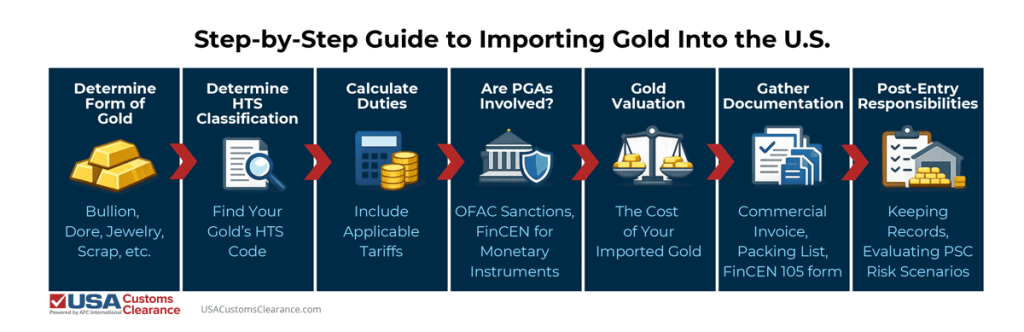
Is Gold Duty-Free When Imported Commercially?
According to the Office of Foreign Assets Control, gold such as coins, medals, or bullion may be entered into the U.S. duty free; however, there are some restrictions and exceptions of which importers should be aware:
- While these gold items may be entered freely and with no limit, they must be reported to a CBP officer at the time of entry. If the value of the items is more than $10,000, you must complete a FinCEN 105 form.
- Gold coins, medals, and bullions from Cuba, Iran, Burma (Myanmar) and Sudan are prohibited from entry into the U.S. Some exceptions can be made to this prohibition via special licensure or exemption from OFAC.
- Copies of gold coins are prohibited if not properly marked by the country of issuance, while counterfeit coins are strictly prohibited.
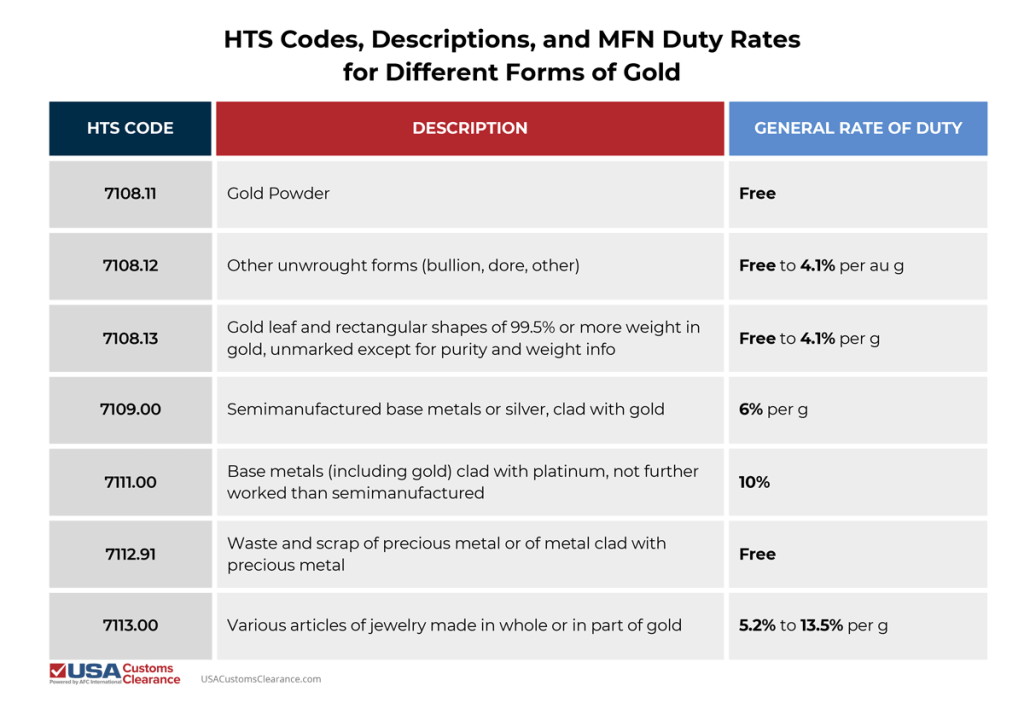
If you’re importing gold commercially, the form of the gold will play an important part in determining duties. While monetary instruments such as government-backed coins can come into the country free of duties, gold imported in powdered, bullion, or dore form (HTS 7108.11.0000 through 7108.13.70) can incur duties of up to 4.1%. Ultimately, duty rates on imported gold vary by purity, the gold’s processing state, and HTS updates/tariff changes.
Gold Import Regulations
Understanding how the U.S. regulates imports of gold into the U.S. starts with knowing which gold items are defined as currency. For example, according to FinCEN, some gold items can be defined as either currency or monetary instruments:
Currency: The coin and paper money of the United States or any other country that is:
- Designated as legal tender
- Circulates
- Is customarily accepted as a medium of exchange in the country of issuance
Monetary Instruments:
- Coin or currency of the United States or of any other country
- Traveler’s checks in any form
- Negotiable instruments (including checks, promissory notes, and money orders) in bearer form, endorsed without restriction, made out to a fictitious payee, or otherwise in such form that title thereto passes upon delivery
- Incomplete instruments (including checks, promissory notes, and money orders) that are signed but on which the name of the payee has been omitted
- Securities or stock in bearer form or otherwise in such form that title thereto passes upon delivery
Monetary instruments do not include:
- Checks or money orders made payable to the order of a named person which have not been endorsed or which bear restrictive endorsements
- Warehouse receipts
- Bills of lading
Gold bullion, gold bars, and gold jewelry do not qualify as monetary instruments or currency for the purposes of this requirement, but must still be declared upon entry.
Import Duties and Taxes on Gold
As stated previously, there is no gold import tax charged for items like gold coins, medals, and bullion entered into the U.S. Commercial shipments of unworked and less refined forms of gold, however, may be subject to duties.
Even when the duty rate is free, commercial entries may still owe CBP user fees, such as the Merchandise Processing Fee (MPF) depending on entry type and value.
That table below lays out most favored nations (MFN) duties for different forms of gold according to their six-digit HTS codes, as well as their range of duty rates. Note: this does not include applicable tariffs such as those invoked by Sections 301 and 232 of their respective trade acts.
Value of U.S. Gold Imports in 2025
According to the Observatory of Economic Complexity (OEC), as of October 2025, the U.S. has a positive trade balance for gold, accounting for $3.17 billion in exports, and $1.39 billion in imports during that month.
The country from which the U.S. imports the most gold by value is Mexico, by a large margin, followed by Colombia and Canada rounding out the top three.
Top 5 U.S. Gold Imports for November 2025
| Country | Value of Gold Imports |
| Mexico | $248 million |
| Colombia | $141 million |
| Canada | $138 million |
| Argentina | $93.2 million |
| Switzerland | $79.7 million |
Import Gold with USA Customs Clearance
What we do:
- Confirm your gold’s form and determine the correct HTS classification and admissibility.
- Screen country of origin and counterparties for OFAC/sanctions risk and flag any restricted-source issues before the shipment moves.
- Verify whether FinCEN reporting applies and help you complete the correct filing when required.
- Review valuation support to reduce classification/valuation holds and exam risk
- Prepare and file your CBP entry, secure the required customs bond, pay duties/fees/tariffs as applicable, and pre-advise stakeholders to minimize holds.
- Coordinate clearance steps with CBP and your carrier/warehouse, and guide post-entry recordkeeping to reduce audit and penalty risk.
Typical timeline: We start the entry process the same business day once we have complete documents and coordinate clearance to match the shipment’s arrival window.
What you’ll need: Commercial invoice, packing list, HTS/product description, quantities/weights, country of origin, exporter/seller details, shipping documents, and any supporting refinery/mint/assay paperwork.
Why choose us: We are licensed customs brokers experienced with precious-metals entries, sanctions-aware screening, and documentation-first entry prep that helps importers avoid preventable delays, exams, or seizures.
Outcome: Your gold is classified correctly, cleared legally with CBP, and delivered without unnecessary storage costs or enforcement risk from avoidable paperwork mistakes. Start your gold entry today or talk to a customs broker now at (855) 912-0406.

 Copy URL to Clipboard

Did you find this article helpful?
See more of our coverage on Google.
Add usacustomsclearance.com as a preferred source!

Add usacustomclearance.com as a preferred source!
See more of our coverage in Google's Top Stories.

my wife is in Brazil her mother passed and left her $1,000,000.00 in gold bars. She is having trouble getting "cleareence" to come back to USA. Suggestions
Please contact me at my email address I need a customer broker for a large gold delivery at that time
CEO Jared Rapaport
I would like to import 150kilos of 24k gold into the US from Ghana with a level of 97.96 purity. Does CBP insist on a higher purity level before clearance.? Apart from fees paid to a licensed customs broker, does CBP charge any additional fees?
My wife is native Ghana and has settled her inheritance of 150 Kilo gold. She would be preparing this next week to bring that to the USA, What details will she need to accomplish to allow that to happen.
I'm going to Ghana, Africa first week of December. I would like help obtaining license to carry back.
4 kilos, 2 bars of gold.
my name is franco masaba American citizen my origin Uganda i have my Dad dead in !994 left Families Gold 2 kilo and diamond 4 bigs stones i want to bring this and sell in america to help pay for school for my brothers and sister what proccess to i need to do get permit or what do i need to do
CAN I TRAVEL WITH GOLD JEWELRY THAT COSTS OVER 70000 DOLLARS?
I have 20 Kilograms of Gold Dore Bars (unwrought) from the Democratic Republic of Congo, that I wish to import into the USA to my company headquarters in Sterling Heights , MICHIGAN ( MS INTERNATIONAL HOLDINGS, LLC ) what is the process, what do I need, how much will it cost me, are there any duties/customs fees for “unwrought” gold ?
Is the 10,000$ limit of gold jwelery to usa per person or a family?
What is the process for importing gold concentrate from a mine in Central Asia?
What is the customs on same?
What does the Customs Bond cover?
I need a license to bring gold and diamond to U.S
If I am using a certified shipping company to get gold to me in the US from Germany, is there a tariff and has to be paid in the US. Could you inform me if there are any more fees after it reaches customs before it reaches me?
If I take a trip outside the country. Is it legal for me to bring it back with me.