


Despite the large size and worth of the ecommerce market, standing out and being successful long-term isn’t an easy feat. Just figuring out how to find suppliers that you can rely on is a challenge. The solution? See how the competition does it. You might be surprised to discover how easy it is to find out where a company imports from.
Key takeaways:
- You can utilize public records, trade data, and professional researchers to find out where a company imports their goods.
- Knowing your suppliers will improve the efficiency of your business and allow you to stay ahead in the market.
- If you can find out where your competitors import from, they can do the same to your business.
- Manifest confidentiality is a great way to keep the details of your supply chain private.
We’ll discuss these points in-depth in the following sections.
How to Uncover Where Companies Import From
When you’re searching for suppliers for your ecommerce business, it makes sense to start by analyzing the competition. Information on suppliers, as well as pricing and common lead times, serves as a strategic asset.
It’s common to use a two-step process:
- Utilize public record and trade data searches for the initial search.
- Hire a professional service that can build an industry specific report.
Public Records and Trade Data
Public databases are treasure troves of information about where companies import from.
Government Resources Available to the Public:
The United States Customs and Border Protection (CBP) keeps records that can be requested and searched to understand trade flows. Among the information they release are Shipping Manifests and Bills of Lading, which reveal the supplier names, shipment details, and other data points.
Online Trade Databases:
These companies pull information from the CBP and organize it in a way that is easy for just about anyone to search. Platforms like Panjiva, ImportGenius, ImportYeti, and others allow visitors to search by company name as well as industry.
They’ll provide the same information as the CBP, but break it down further. For a small fee, they’ll usually supply data on volumes, frequency, and even shipping ports.
Professional Services for Deep Insights
The ability to search records can give new and existing business owners a very detailed snapshot of their industry competitors. However, that amount of information can be overwhelming.
Having the information is one thing, but knowing what it means for your business is much easier with a little professional help. After gathering information on the competition, the next step is to work with a professional trade consultant.
Their professional insights may include:
- An assessment of supplier reliability and product quality
- Industry-specific insights into market trends and supplier networks
- A tailored list of emerging and potential suppliers suitable to your business plan
If you’re truly serious about starting your own business and need to set up for importing, professional advice provides both clarity and saves you time that can go towards finalizing other details.
Why Knowing Your Suppliers Matters in E-Commerce
In saturated markets, knowing your suppliers can be the difference between thriving and failing. Should you manage to carve out a specific niche within a saturated market, the ability to stay there isn’t guaranteed.
To stay on top, you need to make your business efficient and find strategies that keep you ahead of the competition.
Business Efficiency
Efficiency comes in the form of a well managed supply chain. The start of that chain, at least for most ecommerce businesses, is the supplier. There are three significant areas to focus on:
- Operational Cost-Cutting
- Pinpointing efficient suppliers can reduce lead times and inventory costs.
- Logistics based on reliable supplier data minimizes delays and errors.
- Quality Control
- Knowledge of suppliers' standards allows for better quality control of products.
- Consistent quality means fewer returns and increased customer satisfaction.
- Resource Distribution:
- Reliable suppliers reduce the number of necessary quality checks
- Improved focus on branding, marketing, and customer service.
By combining these with other efficient strategies designed to target other areas of your business, you increase your chances of success.
Staying Ahead in the Market
Supplier insights can position your business ahead of competitors. Some insights, such as those provided by trade data, can give businesses an extra edge. However, access to that knowledge by itself, will only take you so far.
When you take the time to reach out and connect with the suppliers you find, more opportunities come your way.
- Exclusive agreements that provide access to unique products
- Stronger relationships can lead to better pricing and first choice of new products
- The ability to customize products to expand options for clients or changing trends
Remember, in e-commerce, differentiation is key to capturing and retaining customers.
The Significance of Protecting Your Supplier Data
Having explored how to find where your competitors import from, it's clear that your supplier information is valuable – and vulnerable. It’s a double-edged sword; as easy as it was for you to find this information, it’s equally easy for others to find yours.
Risks of Unprotected Supplier Information
When thinking of your own supplier information, you really do need to consider the worst case scenario. If a competitor really wants to undermine your business, the information on your suppliers and shipping routes gives them a blueprint to do so.
- By copying your product line up, they reduce your market uniqueness and make your brand feel less innovative.
- In reaching out to your suppliers, they may negotiate better or similar deals to undercut your pricing.
- The potential to interfere with exclusive agreements and flood the market with products, diluting both value and exclusivity.
In a market with as high of a failure rate as ecommerce, every advantage makes a difference. Consider the average survival rates of businesses in 2024 based on their years in operation.
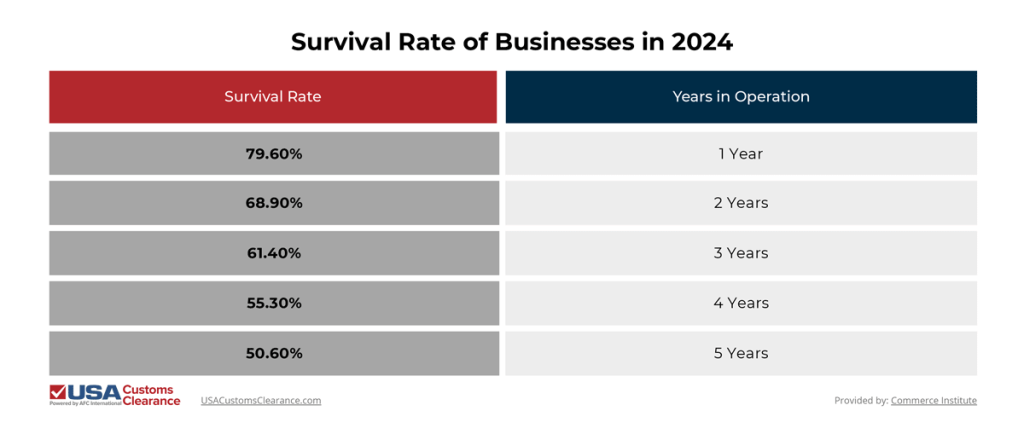
As the data shows, nearly half of all businesses fail by the time they reach their fifth year of operation. The survival rate continues to go down after that, with businesses in operation for 10 years only having a 34.70% survival rate in 2024.
How to Keep Your Supplier Data Confidential
If you’d like to be in business long-term, then you need long-term strategies for success. There are things you can do as a company to protect your most sensitive information.
- Employing data encryption and cybersecurity tools
- Limiting internal access to supplier information
- Training employees on the importance of data confidentiality
Yes, these steps all help keep your business secure. From an internal security perspective, all these things are important.
Here’s the issue: none of those steps will prevent the CBP from releasing your shipping data and supplier details to trade organizations and data mining companies.
For that kind of protection, you need to go straight to the source.
The CBP Manifest Confidentiality Program Explained
Now, the CBP won’t stop collecting your data. Don’t get your hopes that high. Whenever you import products, there are taxes and fees to be paid, inspections to run, and other minutiae that goes with clearing U.S. customs.
What you can have a say in is what the CBP can do with the information after they’ve collected it. Businesses that enroll in the CBP’s Manifest Confidentiality Program can prevent their shipping manifest data from being publicly disclosed.
That’s right. The CBP will have your information, but even if someone were to specifically request your company’s data, they won’t reveal it.
Now, it won’t erase past data. Unless you’ve entered the program prior to any shipping activity, there will be some records still available. The good news is that most people trying to undercut you as a business are looking to do so easily. If your information isn’t obvious, those with bad intentions will likely seek out an easier target.
Learn More: CBP Confidentiality Request: Protecting Company Privacy
Stay Ahead of the Competition With Manifest Confidentiality Filing From USA Customs Clearance
The importance of safeguarding your business's competitive edge should never be overlooked. USA Customs Clearance is here to provide you with an easy, hassle-free option to secure your business data. We offer Manifest Confidentiality filing, a service designed to keep your import data secure and your business strategy protected.
For more information on our Manifest Confidentiality filing service and other import solutions, or to start safeguarding your business, call us at 866-753-7312 or reach out to us on our contact page.

 Copy URL to Clipboard

Did you find this article helpful?
See more of our coverage on Google.
Add usacustomsclearance.com as a preferred source!

Add usacustomclearance.com as a preferred source!
See more of our coverage in Google's Top Stories.

Add your first comment to this post