


Customs bonds are a guarantee that importers will pay applicable duties and taxes for their goods. There are a specific set of requirements you must meet when obtaining one. The slightest misstep can complicate the importing process. Here at USA Customs Clearance, we’ve helped many businesses complete their application to obtain a customs bond. We’ll draw on this experience to explain the requirements you should know.
Key takeaways:
- A customs bond is required when your imports have a value greater than $2,500, regulated by partner government agencies (PGA), or subject to trade remedy actions.
- You can purchase a single-entry, continuous, or temporary import bond (TIB) for your import.
- When applying for a customs bond, you’ll need to provide a variety of information about your business, the goods you’re importing, and your financial stability.
- To obtain your bond, you’ll need to apply for one with a surety or a customs broker.
Now that we’ve covered the basics, let’s look at the requirements that come with customs bonds.
What You Need Before Applying for A Customs Bond
There are multiple requirements you’ll need to meet to apply for a customs bond.
This includes:
- Providing information about your business
- Providing information about the goods you’re importing
- Prove financial stability
First, let’s take a look at the information you’ll have to provide for your business:
- Legal business name
- Address of your business
- Type of business (corporation, LLC, sole proprietor)
- Tax ID and Employer Identification Number (EIN)
- Social Security Number (SSN) for sole proprietors
- Importer of Record (IOR) number
Your historical import history should also be included if you’ve imported in the past. When obtaining a continuous bond, you’ll need to calculate your projected duties, taxes, and fees for the next 12 months.
Next, you’ll provide information about the items you’re importing:
- Descriptions of goods
- Country of origin for the goods
- Estimated value of the goods
The surety company or customs broker providing your bond will want you to prove your financial stability. This helps them determine the risk of you defaulting on your financial obligations.
Information that proves the stability of your company includes:
- Credit reports
- Business tax returns
- Financial statements
If you have a limited credit history or you’re at higher financial risk, a surety or customs broker might ask you to provide collateral. This can be anything from a cash deposit, to a letter of credit.
Get your continuous bond today and import as many goods as you want in an entire year.
When A Customs Bond Is Required
Customs and Border Protection (CBP) require a customs bond in the following circumstances:
- You have a commercial import that’s worth more than $2,500.
- Your goods are regulated by a PGA.
- Your goods are subject to trade remedy actions.
A PGA is another federal agency that works closely with CBP to regulate imports. This includes agencies like the Food and Drug Administration (FDA) and the Department of Transportation (DOT).
Types of Customs Bonds You Can Purchase
There are a variety of customs bonds that you can use based on the needs of your business. However, there are three in particular that are frequently used by importers in the US. We’ve listed them and laid the requirements for their use in the following graphic.
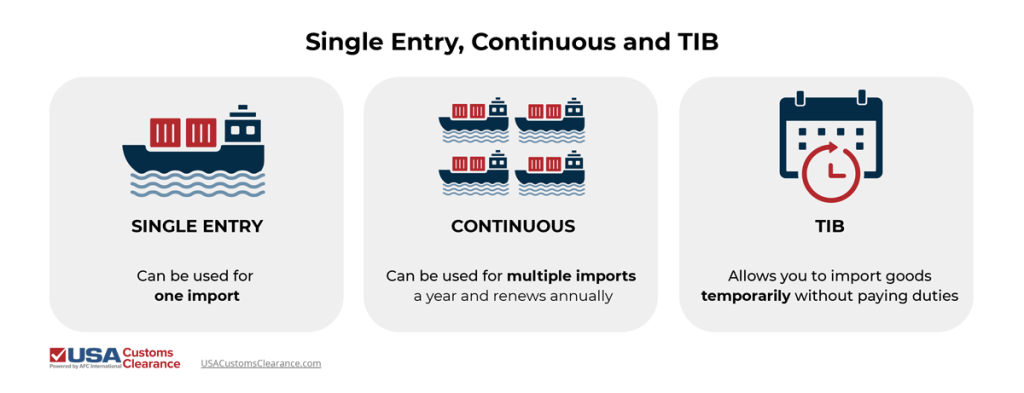
For single entry bonds, the amount required should be equal to the value of the products in your shipment, plus any import duties levied by CBP. The required amount for a continuous bond is typically 10% of the taxes and tariffs. Starting amounts are usually set at $50,000
A single entry bond is great if your business doesn’t import very often, while a continuous bond is the better option if your business frequently imports goods from other countries.
The TIB is can be used in a variety of situations, such as:
- Trade shows
- Conventions
- Repairs
- Merchandise samples
Most TIBs require goods to be destroyed or exported one year after the date of their importation. However, extensions up to three years may be granted by CBP.
Related: Continuous Bond vs Single Entry Bond
Bond Purchasing Requirements
When you purchase a customs bond, you’re required by CBP to take one of two routes.
First, you’ll need to purchase your bond from a surety company that’s licensed by the US Treasury Department. The second is to purchase one from a licensed customs broker.
Typically, large and established companies go to a surety. Smaller companies or individuals that import use a licensed customs broker. The added benefit of using a broker is they can help you through the customs clearance process and monitor your import activity for potential increases needed for your bond.
Any other method of obtaining your customs bond is strictly forbidden by CBP.
Get Your Continuous Bond from USA Customs Clearance Today!
Here at USA Customs Clearance, we provide continuous customs bonds for all our customers. With this important electronic form, you’ll be able to import any number of imports for an entire year. We also offer a variety of other import services like consulting sessions with Licensed Customs Brokers.
If you’re ready to get the importing services that you need, then give our team a call today at (855) 912-0406. You can also reach us through our contact page.
Duties & Tariffs Can Change
You can't afford to overlook changes in import duties and tariffs.
Product materials and country of origin can afftect what you pay. Your landed cost calculations will include the latest fees.

 Copy URL to Clipboard

Did you find this article helpful?
See more of our coverage on Google.
Add usacustomsclearance.com as a preferred source!

Add usacustomclearance.com as a preferred source!
See more of our coverage in Google's Top Stories.

Add your first comment to this post